Saturday, January 7, 2012

Effects Of The War In LAOS

During the War from 1964 to 1973 more than 2 million tons of ordnance were dropped in LAOS. That averaged one-half ton for every person in the country at that time. LAO was the most heavily bombed country, per capita, in the world. More than 30% did not explode on impact. This has caused a continuing problem for the population today. Reportedly, it will take 150 years to clear the land at the current rate of operation. In the Xieng Khuang Province, an average of 1 person per day was killed in the 9 year war.

On our visit to Xieng Khuang where the Plain of Jars are located, we saw numerous bomb carters and trenches.

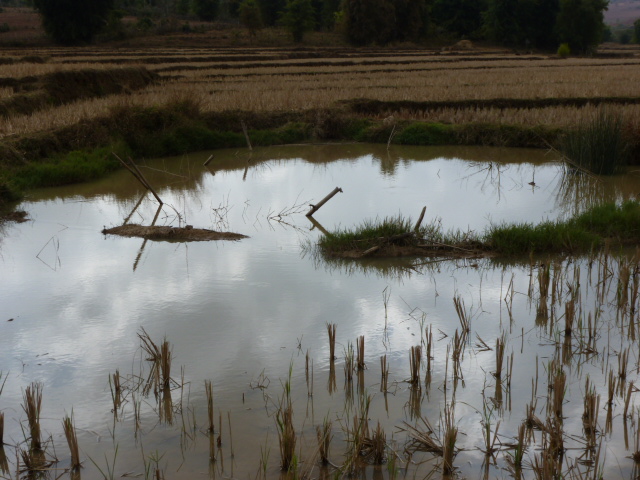
This crater now serves as a fish pond.


In visiting the Plain of Jars, the pathways were marked with white markers placed by MAG (Mines Advisory Group). MAG's job is to clear the UXO's. On the Plain of Jars, 175 UXO's have been destroyed.


MAG continues to train LAO people to detect and learn how to detonate UXO's. As we were driving through a village, we happened to see a team of 3 women working in a field. A worker who has been certified by MAG receives a salary of $55 per week.


This is the team leader.


Note the two piles of light brown soil. They had just unearthed a bomb.


In the villages close to the Jars, 1444 UXO's were destroyed. Of the agricultural land near the Jars, the equivalent of 19 football fields have been cleared. On the walking paths between sites 2 and 3, a total of 19 UXO's were destroyed.

A photo of Xieng Khuang Province the red dots show the number of UXO's that had been dropped.

Digging for metal to sell, illegally, to scrap metal dealers creates one of the biggest problems for the LAO people. Scrap metal brings in more than an average family earns in one month. However, the effects of UXO's exploding lead to death and injury.


People have used the scrap metal to use in various ways.


Note the supporting corner post and those by the door of this buffalo house. They are bomb casings.


All these tools, except for the shovels, were made from bomb metal scraps.


A school bell made from a 2000 pound bomb.


A spoon made from the aluminum of an airplane.


Two hundred fifty million submunitions (bombies) were dropped in the country. The cluster bomb is 4.9 feet long and contains 670 tennis sized balls. Each bombie projects 30 steel pellets 66 feet. Tens of millions of bombies remain imbedded in the land. Children often find these and use them as a toy, not realizing that they can explode. This photo is from the Visitor's Center.


In the January 6, 2012 Vientiane Times, there was an article about a bull dozer worker who was working on a new road, struck a 2000 pound bomb. Fortunately, it didn't explode. Experts said it was capable of destroying an area with a radius of 1.2 miles.

During the war, bombs were dropped on LAO at an average of 1 every 8 minutes for 9 years.

Thursday, January 5, 2012

Xieng Khuang and the Plain of Jars

On January 3-5, we flew with Andy to Xieng Khuang Province in Northeast Laos. There are 7 sites of jars that have been cleared of UXO's (Unexploded Ordnances) out of 90 that have been discovered. There are 3 sites that can be visited. The jars are scattered over 100's of square kilometers. This is an area of Laos that we have wanted to visit for several years.

No one knows for certain the origin of the jars. However, there are some theories. These include:
1. They were used as burial jars from 500 BC to9 200 AD which is the Southeast Asia Iron Age. They were made from a conglomerate of stone akin to sandstone and a few made from granite. Archeologists have confirmed that the jars are carved from solid rock.
2. The locals theory is that the were made to brew rice wine to celebrate the local peoples 6th C. liberation from cruel overlords. They believe that the jars cast from a mixture of buffalo skin, sand, water and molasses.

Site 1 has the most and largest jars. It contains 334 jars or fragments.


This one of the taller ones.


This is the largest jar, Hai Jeuam. It weighs 6 tons and is 2.5 meters high (8.2 feet).


This site has 2 levels and the theory is that the more important persons were buried at the higher site. This is a view of the lower site.


The cave was believed to house the kiln to form the jars. This is the locals theory. The cave was also used during the war by the locals to for protection from the heavy bombing in the area during the Vietnam War.


No one knows if the jars had lids. But, we occasionally saw some jars with lids and some lids on the ground or partially buried in the ground.


Site 2 was 10 kilometers from the main paved road. Sites 2 and 3 can only be visited in the dry season since the roads are muddy and slippery. Also, the roads are covered with leaches in the rainy season.

At site 2, there are 94 jars or fragments. It is located on two hilltops in a pine forest. There are more unusual shapes at this site - square, rectangular besides the circular.


The tree grew through a crack in the stone jar.


At the entrance to Site 3, we had lunch at a local noodle restaurant. Note the stairway entrance. Ruthann posed with the owner/cook.


Large bowls of chicken pho (noodle soup) were enjoyed. We wiped off the chopsticks and spoons with our toilet paper napkins. Note the size of the bowls. The owner said that all vegetables were grown organic.

We did a 10 minute walk to Site 3. At this site there are 150 jars and fragments.


You'll notice that we were wearing jackets. The temperature got down to 46 at night and during the day, it was cloudy and some wind. Our guide said that it got down to 35 degrees two weeks before we came and that some water buffalo had died.

We did have a guide who spoke English. The driver was excellent.

Tuesday, December 27, 2011

Christmas Scenes from Vientiane, LAOS

In Vientiane, we see signs of Christmas. There are various types of Christmas trees and other symbols.

Kris and Andy light the Advent Wreath at Church.


A Christmas tree at the Morning Market and the only snow you see in Vientiane is on this poster in front of the Market.

Poinsettias are abundant around town.


And this is the most unique Christmas tree that we saw. It's made out of beer cans from Beer Lao factory.


Andy is trying on his goalie gloves that he got as a present.

Saturday, December 17, 2011

Christmas Carols At The US Ambassador's Home

On Saturday afternoon (Dec. 17), the people from Kris' church were invited to the US Ambassador's home to sing carols. The Ambassador, Karen B. Stewart, attends the church along with her personal secretary. We were treated to homemade cookies and soft drinks. This was a real treat for us.

This is the front entrance to the residence.

We had our photos taken with the Ambassador and her Secretary.


Kris and Nancy Ambassador's Secretary


Kris, Ambassador Karen, Ruthann, & Chet


There were several art pieces in the house on loan from the artists. There was a series of fabric wall hangings. One is behind us in the above photo. One wall hanging was make by Nancy Reno from Lancaster, PA.


Table with the goodies


Some scenes from the caroling.


Wendy, MCCer, GC Grad at the piano

Note that Wendy is barefooted. All our shoes were left at the front door. A list of all the attendees needed to be submitted a week before the event so that the list could be checked by the Embassy.

Sunday, December 11, 2011

Our First Morning Walk in Vientiane

This morning, we took our first walk in Vientiane. It's not a good idea to walk until after 8:30 AM due to the traffic. Even at that time, we noticed significant increase in traffic volume. We also noticed the amount of construction that was occurring around the city. One of the walks that we do is to the monument That Luang. It has a large parking lot that many people use to walk, jog and exercise. However, 3 policeman stopped us and indicated that we couldn't walk in the parking lot. The reason, Parliament was in session today. So we said thank you and went to the sidewalk.


This building pictured above is the new police museum.


The large parking lot is where we usually walk, but today, not to happen. The buildings are the Parliament. This is as close as we could get today.


That Laung the most important national monument in Laos. It is a symbol of both Buddhist religion and Lao sovereignty. It is a large stupa, which is a burial place, and was built in the 3rd century BC. In all the temples, you can see stupas on the grounds since the bones of Lao peoples are buried in them after cremation.

Here are photos of some of the other sights that we saw this morning.

This is a reclining Buddha constructed out of cement and below is the model of what the Buddha will look like when completed.


Ice Cream delivery!!!


We met this woman who was selling brooms when walking home to Kris' house.